The Low-Voltage Field Soldering Trade-Off
For decades, reliable field soldering meant hauling butane torches or finding an AC outlet for a 40-watt pencil iron. The proliferation of ubiquitous 5V USB ports and lithium-ion cells has permanently changed small-scale electronics maintenance.
Today, compact USB-C soldering irons provide hobbyists, automotive technicians, and field technicians with ultra-lightweight alternatives capable of tackling wire splices, quick terminal tacking, and light circuit board rework. However, moving away from mains-powered bench stations introduces clear technical compromises in thermal recovery, power delivery, and continuous run time that require careful evaluation.
Core Engineering Criteria for USB Soldering Irons
Power Delivery Architecture
Tethered direct-plug irons bypass cell wear for indefinite bench run time, while 800mAh and 1000mAh internal batteries offer complete mobility in cramped quarters.
Thermal Output Constraints
Operating between 7W and 15W on 5V or 3.7V rails, these low-mass tips rely on quick thermal conduction rather than deep energy reservoirs.
Control & Temperature Interfaces
Options range from multi-color 3-level and 5-gear stepped selectors up to digital displays managing spans between 260°C and 450°C.
Floating Electrical Grounding
Unlike dedicated lab stations with grounded ESD earth references, budget USB irons float on DC rails, demanding care around static-sensitive CMOS components.
Technical Comparison of Current Portable Models
| Product | Model Configuration | Reference Price | Power Architecture | Thermal Span | Control Interface | Feedback Score |
|---|---|---|---|---|---|---|
| Cordless USB Digital Soldering Iron Adjustable Temperature… | Cordless USB Digital Iron | $11.57 | Integrated 1000mAh Battery | 300–450°C | Digital Display | 93.7% (2,820 reviews) |
| No Battery Model Mini USB Soldering Iron Type-C plug-in Three… | No-Battery Mini USB Plug-In | $6.81 | Direct Type-C Tethered | 3-Level Regulation | Tri-Color LED Indicator | 98% (3,256 reviews) |
| USB Electric Soldering Iron Kit Type-C 5 Gears DC3.7V 2A… | USB Electric Kit DC3.7V 2A | $4.37 | Direct Type-C (3.7V / 2A profile) | 260–420°C | 5-Gear Step Selector | 98% (1,208 reviews) |
| USB soldering iron mini small soldering iron set portable… | Mini Household Set (800mAh) | $11.91 | Integrated 800mAh Battery | Adjustable Multi-Level | Single-Button Stepped Interface | 98% (8,753 reviews) |
| USB Digital Display Soldering Iron Type C Mini Soldering Iron… | USB Digital Display Set | $4.33 | Direct Type-C Plug-In | 260–420°C | Digital Readout / 5 Settings | 98% (5,324 reviews) |
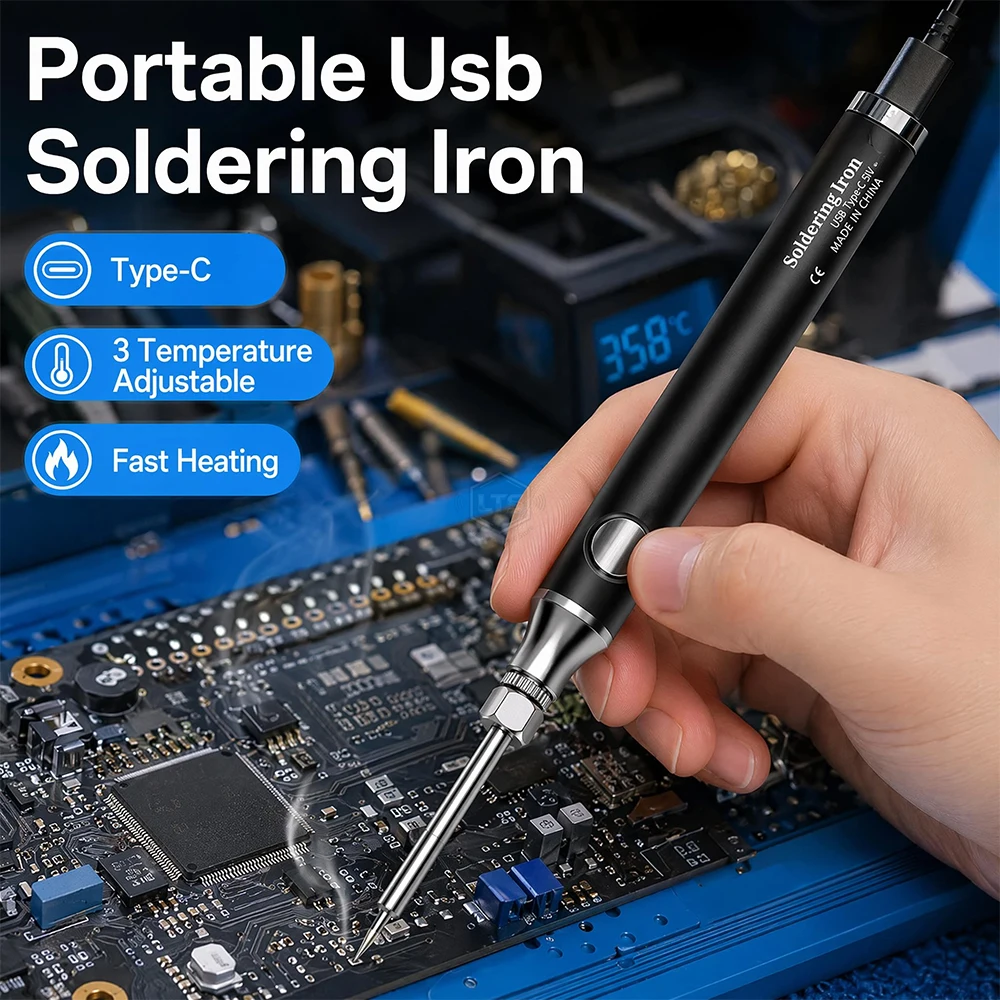
Direct Plug-In Evaluation: No-Battery Mini Type-C
Pros
- Lightweight, slender chassis stays cooler without an internal electrochemical cell
- Continuous power draw eliminates battery degradation and run-time cutoffs
- Simple three-level indicator scheme minimizes failure points
Cons
- Requires a continuous tether to a 5V power bank or USB power adapter
- Limited thermal mass requires extra contact time on heavier joints


Field Deployment Checklist
- Assess Target Joint MassReserve USB irons for wire splices up to 24AWG, sensor leads, and small pads rather than multi-layer ground planes.
- Confirm Power Supply RatingVerify that USB ports or portable power banks can continuously deliver a stable 5V or 3.7V 2A output profile.
- Mitigate Electrostatic ExposureImplement external grounding straps when handling sensitive CMOS microcontrollers on floating DC power.
- Plan Battery Duty CyclesRecharge integrated 800mAh and 1000mAh units between service stops to avoid voltage sag mid-repair.
Operational Constraints & Practical Trade-Offs
- Low overall thermal wattage (7W to 15W) makes desoldering multi-layer copper ground planes or 12AWG leads impractical.
- Internal 800mAh and 1000mAh lithium cells experience heat soak adjacent to the heater barrel, accelerating battery capacity loss over time.
- Budget USB-C irons operate on floating DC rails without mains earth bonding, increasing risk during static-sensitive CMOS repairs.
Bench Recommendation
Choose tethered USB irons for recurring bench work; select internal lithium models solely when cord-free portability is essential.
Direct plug-in models avoid battery decay and thermal bulk while delivering consistent power. Cordless designs provide unmatched access in tight automotive looms or drone fields, provided jobs are brief.
Evaluation Context & Methodology
Known facts
Product ratings, prices, and specifications were cross-referenced from verified marketplace listings covering over 21,000 combined reviews.
Units evaluate direct USB Type-C input rails and internal 3.7V lithium-ion cells with capacities between 800mAh and 1000mAh.
Temperature spans range from 260°C to 450°C across stepped and digitally regulated interfaces.
Analysis
Marketplace telemetry demonstrates consistent satisfaction (93.7% to 98%) when low-voltage irons are confined to appropriate light-gauge tasks.
Tethered irons exhibit longer operational lifespans because they lack internal cells subject to repeated thermal stress.
Uncertainties
Actual tip temperature accuracy on floating budget circuits may vary from numerical display values under thermal loading.